
The chapter entitled Human Eye and Colourful World allows schools to understand how students think of colour in the natural world and understand how students look at things. Lucky Industries provides high-quality science lab kits to schools, institutions, and those who wish to learn about sciences through hands-on experiments and at a very economical price. The science lab kits are chosen by Teachers searching for lab supplies in their local area because the Lucky Industry lab kits simplify the understanding of complex subjects through practical experiments and hands-on learning. With over 30 years of experience within the industry, Lucky Industries has created a user-friendly way to present scientific topics to young students. For questions regarding price, tariffs, and bulk orders, Lucky Industries may be contacted anytime at +91 9030919029 .
Here we explains why the human eye works like a camera, how the eye forms images, why defects of vision occur, and how the colorful world appears due to refraction, dispersion, and scattering of light. Students can perform simple experiments from our science lab kits to understand these concepts clearly.
A colorful world and human eye look at the structural components of the human eye. The eye allows for natural vision through optical means. It enables us to see, shape, colour, and detect movement. The overall study of the eye provides students with a more comprehensive knowledge of the functioning of the eye.
The human eye is a spherical organ about 2.5 cm in diameter. It has several parts that work together to create a clear image. Lucky Industries science lab kits include eye models and charts that help students observe these structures without needing costly equipment.
Structure of the Human Eye
Human Eye and Colorful World also covers the major parts of the human eye. Each part plays a special role in forming vision. The main parts are:
The cornea is the transparent front layer of the eye. It bends most of the light that enters the eye. It protects the inner parts from dust and germs.
The iris is the colored part of the eye. It controls the size of the pupil and manages how much light enters.
The pupil is the opening in the center of the iris. It becomes small in bright light and larger in dim light. This natural adjustment protects the retina.
The lens focuses light rays on the retina. It changes its shape to adjust the focal length. Students can understand this better using our convex lens experiments included in lab kits.
These muscles help the lens change shape. They relax or contract to adjust the focus.
The retina has light-sensitive cells called rods and cones. It converts light into electrical signals that reach the brain.
The optic nerve carries signals from the retina to the brain. The brain then forms the final image.
Human Eye and Colorful World explains that the eye forms a real, inverted, and smaller image on the retina. The brain flips the image to help us see it correctly.
Students can understand image formation through simple experiments with lenses. Lucky Industries offers lenses, ray diagrams, and optical tools at a reasonable price so schools can teach this topic with clarity.
The power of accommodation is the eye’s ability to adjust the focal length of the lens. This helps us see near and far objects clearly. Ciliary muscles help change the curvature of the lens.
When we look at a nearby object, the lens becomes thicker. When we look at a distant object, the lens becomes thinner. Our lab kits contain a working model that shows this process in a simple and clear way.
Human Eye and Colorful World also covers vision defects caused by problems in the eye’s lens or shape. Lucky Industries provides affordable optical components so students can understand these defects without high charges.
The main defects are:
A person with myopia sees nearby objects clearly but distant objects appear blurry. The image forms in front of the retina. It is corrected using a concave lens.
A person with hypermetropia sees distant objects clearly but struggles with near objects. The image forms behind the retina. It is corrected using a convex lens.
This defect occurs due to aging. The ciliary muscles weaken and the lens loses flexibility. It is corrected using bifocal lenses.
This defect occurs when the cornea is not smooth and evenly curved. It leads to blurred or distorted vision.
Students can test different lenses available in our science lab kits to check how these defects are corrected in real life.
Human Eye and Colorful World also explains why the world appears so colorful. Light interacts with objects in various ways. These interactions include refraction, dispersion, and scattering of light.
Lucky Industries adds experiments like prism refraction, rainbow formation, and light scattering setups that help students understand these concepts without extra price increases.
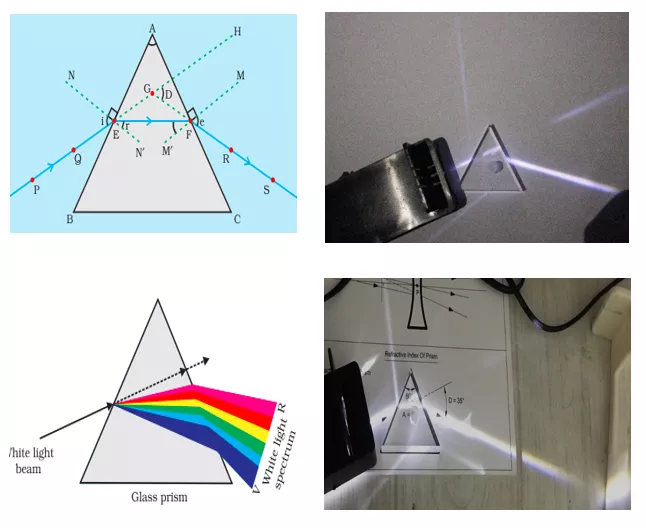
Refraction of Light Through a Prism
When white light passes through a prism, it bends and splits into seven colors: VIBGYOR. This process is called dispersion. Students can perform this experiment using the prism included in our lab kits.
Why Dispersion Happens?
Different colors have different wavelengths. They bend differently when passing through a prism. Violet bends the most, while red bends the least.
This is why we see a beautiful color band called a spectrum.
Formation of Rainbow
A rainbow forms when sunlight enters water droplets in the atmosphere. The light undergoes refraction, dispersion, and total internal reflection. Lucky Industries includes simple models to help students explain rainbow formation without complex tools.
Human Eye and Colorful World describes how light bends as it travels through layers of air with varying density. This concept explains many natural phenomena.
Twinkling of Stars
Stars appear to twinkle because the light from stars bends several times before reaching our eyes. This bending causes the star’s brightness to change.
Why Sun Appears Red During Sunrise and Sunset
Light from the sun passes through a thicker layer of atmosphere during sunrise and sunset. Shorter wavelengths like blue scatter away, while red reaches our eyes. Students can understand scattering through simple torch-and-smoke experiments included in our lab kits.
Scattering is the process where particles in the air spread light in different directions. This explains many natural events:
The sky looks blue because shorter wavelengths scatter more. Blue light scatters in all directions, making the sky appear blue.
Red light scatters the least. It reaches our eyes even when the sun is at a low angle.
Red travels the farthest without scattering much. That is why red color is used in traffic signals and warning signs.
Lucky Industries designs lab kits that match CBSE’s activity list. Schools searching for "science lab kits near me" find our products reliable due to their strong build, low cost, and simple instructions.
Activity 1: Image formation through a convex lens
Students use a convex lens and screen to understand image creation at various distances.
Activity 2: Refraction through a glass slab
This helps students understand bending of light.
Activity 3: Dispersion of light through prism
Students observe the formation of the spectrum.
Activity 4: Demonstration of scattering of light
A beam of light passing through smoke or dust shows how scattering works.
Each activity comes with step-by-step instructions at no extra charge.
Schools often look for high-quality science lab kits at a reasonable cost. Lucky Industries provides durable optical kits, prism sets, lenses, ray boxes, and eye models for Class 10. Every kit is packed with clear instructions so teachers can conduct experiments easily.
We offer:
Whether you search for “science lab kits near me,” need a customized set, or want a school-level optical experiment box, we provide the perfect options.
Human Eye and Colorful World teaches students how the eye works and why we see a colorful world around us. Concepts like image formation, defects of vision, dispersion of light, scattering, and atmospheric refraction help students understand science beyond textbooks. At Lucky Industries, we support this learning with affordable, safe, and high-quality science lab kits designed for CBSE schools. Our products help students visualize concepts, perform hands-on experiments, and gain confidence in science. For price details, customized orders, or kit charges, call +91 9030919029 anytime. We are committed to helping schools across India learn science the smart way.
The human eye is a natural optical instrument that allows us to see objects around us.
Stars twinkle due to atmospheric refraction of their light.
It is the eye’s ability to adjust the lens to focus on near and far objects.
The sky appears blue because shorter wavelengths scatter more.
Dispersion is the splitting of white light into different colors through a prism.
Myopia is corrected using a concave lens.
The Sun looks red because longer wavelengths scatter less.
A rainbow forms due to refraction, dispersion, and reflection of sunlight in water droplets.
Hypermetropia is long-sightedness corrected using a convex lens.
Schools can call +91 9030919029 to order affordable science lab kits.