
Notes of Human Eye and Colourful World Class 10 explain how the eye helps us see the beautiful world around us. At Lucky Industries , we support schools, institutions, and students with high-quality science lab kits at an affordable cost and price. These notes help students understand the chapter easily and prepare well for exams. Teachers searching for reliable study material near me or lab kits near me can count on us. Our aim is to offer simple, clear, and practical learning support for every student.
What is the Human Eye?
Notes of Human Eye and Colourful World Class 10 begin with the human eye, a natural optical device. It works like a camera. It forms real and inverted images on a screen called the retina. Through lens adjustment, the eye allows us to see objects at various distances.
Structure of the Human Eye
Notes of Human Eye and Colourful World Class 10 explain the eye's structure in a simple way. Understanding these parts is essential for practical experiments using lab kits from Lucky Industries.
The cornea is the clear, curving front portion of the eye. It bends most of the entering light.
The iris is the coloured part. It regulates how much light enters the eye.
The pupil is the opening at the centre of the iris. It grows larger in dark light and shrinks in strong light.
The eye lens is a convex lens. It helps focus light on the retina.
These muscles change the lens’s shape to adjust focus. This process is called accommodation.
The retina works like a screen. It has rod and cone cells. Rods help in dim light. Cones help in bright light and colour vision.
The optic nerve carries visual signals to the brain.
Power of Accommodation
Notes of the Human Eye and Colourful World Class 10 emphasize accommodation, which is the eye's capacity to see both close and distant things with clarity. The eye lens changes its focal length using the ciliary muscles.
How It Works
Defects of Vision
Notes of Human Eye and Colourful World Class 10 cover three common eye defects. Lucky Industries lab kits help students perform these experiments safely.
Cataract
Notes of Human Eye and Colourful World Class 10 also include cataract. In this condition, the lens becomes cloudy. It causes vision loss. Doctors remove the cloudy lens surgically and add an artificial lens. The charge and cost vary depending on hospital and location near me.
Refraction of Light Through Prism
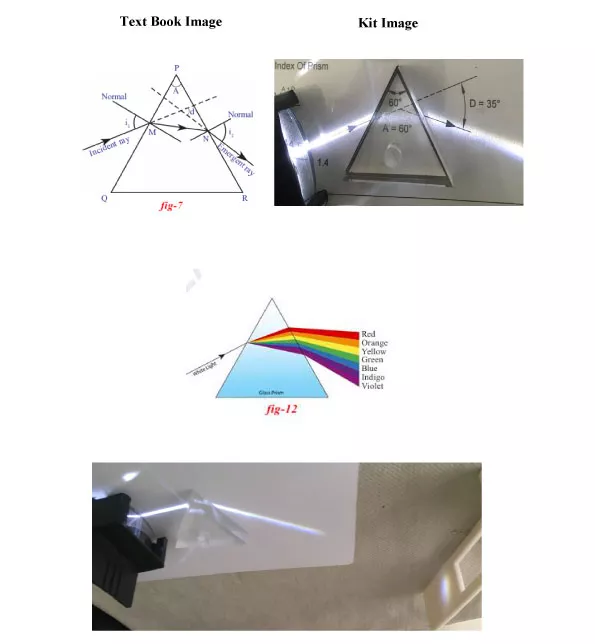
Refraction is explained in Notes on the Human Eye and Colorful World Class 10. Light bends when it moves from one medium to another. In a prism, refraction separates white light into seven colors. This is the process of dispersion.
Spectrum
The seven colours are: Violet, Indigo, Blue, Green, Yellow, Orange, Red (VIBGYOR)
Dispersion of Light
Dispersion occurs when different colours bend at different angles. Violet bends the most. Red bends the least.
Rainbow Formation
Notes of Human Eye and Colourful World Class 10 highlight rainbow formation in nature.
Steps:
Rainbows appear when the Sun is behind the observer and rain is in the front.
Atmospheric Refraction
This effect occurs when light travels through layers of air of different densities.
Applications:
Tyndall Effect
The Tyndall effect is explained in Notes of Human Eye and Colourful World Class 10. It is the result of tiny particles suspended in a medium scattering light.
Examples:
Why is the Sky Blue?
Scattering makes the sky appear blue. Due to its shorter wavelength, blue light scatters more. The blue light is dispersed and visible from every angle.
Why is the Sun Red During Sunset?
During sunset, sunlight travels a greater distance through the atmosphere. Most blue light scatters away. Red light scatters the least and enters our eyeballs.
Notes of Human Eye and Colourful World Class 10 show how these concepts appear in daily life.
Use different colours based on wavelength visibility.
Understanding the eye helps in treatments like cataract surgery and power correction.
Lucky Industries provides lab kits for prism experiments, refraction, and dispersion demonstrations at affordable cost and price.
Notes of Human Eye and Colourful World Class 10 help students understand how the human eye works and how colours appear in nature. Concepts like refraction, dispersion, scattering, and eye defects play an important role in daily life. Lucky Industries supports every school and student by offering reliable, affordable, and simple lab kits. These practical tools help students learn science with confidence and clarity. Our mission is to make science easy, enjoyable, and accessible to all.
The human eye is a natural optical device that helps us see objects around us.
Accommodation is the eye’s ability to focus on near and far objects.
Myopia is a defect in which a person sees near objects clearly but far ones blurred.
Hypermetropia occurs when a person sees far objects clearly but struggles with near ones.
Dispersion is the splitting of white light into seven colours.
It is the scattering of light by small particles in a medium.
The sky looks blue due to strong scattering of blue light.
Red light scatters less, so it reaches our eyes during sunset.
A rainbow is a natural spectrum formed due to refraction, dispersion, and reflection inside raindrops.
You can buy high-quality lab kits from Lucky Industries near me.